

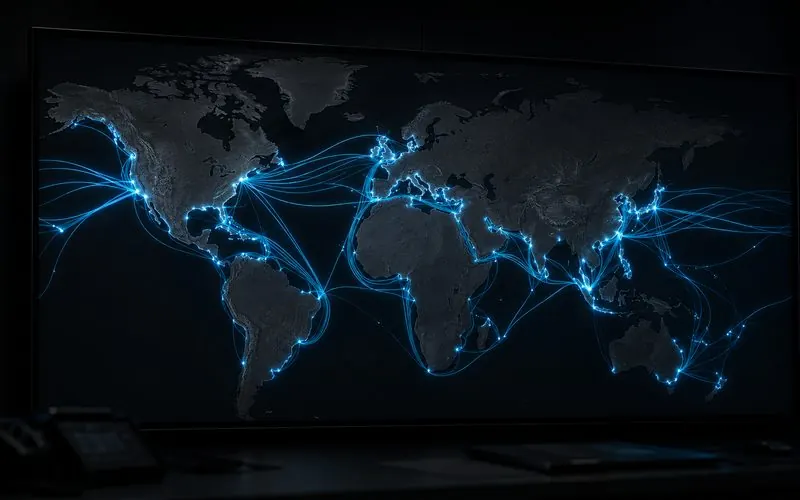
Building a private Anycast edge from scratch
Why some of our clients run their own ASN, IP blocks, and edge — the trade-offs vs Cloudflare, and how the math actually works.
The short answer
Private Anycast means owning your own ASN, IP blocks, BGP peering across multiple points of presence, and the traffic-engineering layer that ties them together — instead of running your edge through a provider like Cloudflare. It makes financial and operational sense mainly for operators carrying geopolitical, account-status, or data-sensitivity risk from depending on a hyperscaler, or for anyone sustaining enough egress (roughly 3 Gbps+) that the economics flip in favor of owning the network. Gaming and casino operators are the largest single client group for this because CDN account-status risk under a hyperscaler's acceptable-use terms can interrupt traffic across every license they hold at once — not a theoretical risk, a recurring one. Below that risk profile or that traffic volume, a Cloudflare-class provider remains the better call.
Who needs this
If you are running a SaaS product on Cloudflare and shipping 99% of your traffic through their edge, do not build a private Anycast network. The marginal benefit doesn't justify the operational complexity. Cloudflare is genuinely one of the best products in our industry, and we use it for our own marketing site.
The clients we deploy private Anycast for typically share one of these characteristics:
- High geopolitical risk: Operating in markets where dependency on a US-headquartered provider is a strategic liability — for example, a regulated business with significant non-Western customer bases.
- Account-status risk: Their business model is legally permitted but contested by the major providers' terms of service. Gaming and gambling operators see this acutely.
- High customer-data sensitivity: They cannot accept a hyperscaler being in the TLS-terminated data path.
- Scale economics: At sustained multi-Gbps egress, hyperscaler edge pricing crosses a threshold where rolling your own becomes substantially cheaper.
If none of those apply, stick with Cloudflare. The rest of this article assumes one or more do.
What "private Anycast" means in practice
Private Anycast means owning the four things that make global Anycast work as a network primitive:
1. Your own Autonomous System Number (ASN)
Issued by a Regional Internet Registry (RIPE for EU, ARIN for North America, APNIC for APAC, LACNIC for South America, AFRINIC for Africa). Under RIPE's 2026 charging scheme, budget €1,800/year base LIR membership plus a €50 per-ASN assignment fee — call it ~€1,850/year all-in for a single ASN, up from the flat ~€1,400 we quoted here in prior years. Your name (or your holding entity's name) is on the registration. You announce routes; you carry the responsibility for them.
2. Your own IP blocks
IPv4 is now a secondary market — 2026 broker pricing runs roughly €23–€45 per IPv4 address depending on block size and region. A /22 (1,024 addresses) runs €24K–€46K capital outlay. IPv6 is plentiful: a /48 IPv6 block from RIPE costs essentially nothing as part of your annual ASN membership and gives you 1.2 × 10²⁴ addresses, more than you'll ever need.
If you don't own the IPs, you don't have leverage. Transit providers can stop announcing them, regulators can lean on whoever does own them, and you're back to depending on someone else's good behaviour.
3. BGP peering at multiple PoPs
Either via Internet Exchange Points (IXPs) or commercial transit providers, ideally both. The major IXPs (DE-CIX Frankfurt, AMS-IX Amsterdam, LINX London, JPNAP Tokyo, Equinix Singapore) give you direct peering with hundreds of networks at a flat monthly cost.
A small deployment looks like:
- Frankfurt: DE-CIX + a Tier-1 transit
- Amsterdam: AMS-IX + a Tier-1 transit
- Singapore: Equinix SG + a regional transit
- One US PoP, usually Equinix DC or LAX
That's four PoPs with ~8 BGP sessions, plenty of redundancy.
4. Traffic engineering, health checks, and failover
The boring part. BGP gives you reachability; traffic engineering is what makes one PoP take more load when another is under attack, what fails clients over when a transit provider has a bad day, what biases your routing so that Frankfurt customers don't get routed through São Paulo.
Standard stack: Bird/FRR for BGP, a health-check daemon that withdraws routes when local services fail, a route reflector if you have more than a handful of PoPs.
A real deployment we did
A licensed European gaming operator had been through two account-status reviews at major US-based edge providers in 18 months. Each one was resolved without consequence, but each one represented a risk of being interrupted at zero notice. They asked us to build them an independent edge.
The engagement ran 19 days from kickoff to traffic-cutover. Six PoPs:
| PoP | IX | Why |
|---|---|---|
| Amsterdam | AMS-IX | Continental Europe gateway |
| Frankfurt | DE-CIX | DACH market + redundancy to AMS |
| London | LINX | UK regulatory zone |
| Singapore | Equinix SG | SEA traffic |
| Tokyo | JPNAP | NE Asia |
| São Paulo | IX.br | LatAm |
The operator's existing hardware (8 × edge servers) was redeployed across the new PoPs. They bought a /23 IPv4 block on the secondary market (€32K), and got an IPv6 /48 from RIPE alongside their new ASN. Moving their live, real-money traffic onto the new edge was its own phased exercise, separate from the build above — see migrating a live casino to private Anycast without downtime for the cutover runbook.
Outcome at 12 months:
- Zero account-status incidents.
- Monthly edge spend reduced by 41% compared to their previous hyperscaler line items.
- 99.97% uptime measured by independent synthetic monitoring.
- Two production-impacting incidents, both resolved within the operator's SLA — one a BGP fat-finger at their secondary transit, one a fibre cut between FRA and AMS.
Why this comes up so often with iGaming and casino operators
Of the clients we've built private Anycast for, licensed gaming and casino operators are the largest single group — alongside crypto exchanges and other privacy-sensitive operators. Two things about the sector make the account-status risk described above concrete rather than theoretical:
- Licensing is jurisdiction-by-jurisdiction, not global. An operator licensed in Malta, the UK, and Curaçao serves regulated traffic from all three markets simultaneously. A single CDN account covers all of it — which means a single account-status review at that provider can interrupt traffic across every license you hold, not just one.
- "Gambling" sits inside every major hyperscaler's acceptable-use grey zone. Even fully licensed operators get flagged by automated compliance tooling that doesn't distinguish a regulated sportsbook from an unlicensed offshore book. The review itself is usually resolved without consequence — but the interruption risk during the review is real, and it recurs. The deployment we walked through above involved an operator who had been through two such reviews in 18 months before deciding to build independent infrastructure.
None of this is a knock on the hyperscalers' compliance teams doing their job. It's the structural reason gaming operators, more than most sectors, end up owning their edge instead of renting it. If you're evaluating this for a casino or sportsbook brand specifically, the DDoS Protection tuning and Security Hardening work that pairs with the build matters more here than in most verticals — a private edge that isn't hardened against L7 floods just moves the risk from "account ban" to "uncushioned attack surface."
Crypto exchanges land on this decision from a different angle than account-status risk — private Anycast for a crypto exchange covers the shared-provider mitigation-queue problem specific to that vertical, separate from the reasoning above. Digital banks and fintech platforms arrive from a third angle again — a regulatory one: private Anycast for a digital bank covers how DORA's ICT concentration-risk assessment treats a single-CDN edge as a hard-to-substitute dependency, distinct from both the account-status risk above and the crypto exchange's mitigation-queue risk.
Where it costs more than people expect
Operations. Once you own the ASN and the boxes, you own the incidents.
- BGP misconfigurations are now your problem. Announce the wrong prefix, get an angry email from Hurricane Electric.
- Hardware refresh cycles are now your problem. Plan 5-year capex.
- Peering relationships are now your problem. Building peering across IXPs is partly a technical job and partly a relationship job.
- Regulatory questions arrive at your door, not your provider's door. This is mostly an upside — you control the response — but it is a workload.
Most clients pair the setup engagement with an ongoing operations retainer for the first 6–12 months. The retainer typically includes Security Hardening of the edge stack and DDoS Protection tuning during the first attacks against the new network. Some take over operations after a 90-day transition. Both work.
The honest comparison
| Cloudflare-class provider | Private Anycast | |
|---|---|---|
| Setup time | Hours | 2–4 weeks |
| Annual baseline cost | Lower at small scale | Lower at large scale (>~2 Gbps sustained) |
| Operational burden | Outsourced | Yours, or retained to us |
| Account-status risk | Real | Zero |
| Customisation | Limited to product feature set | Total |
| Out-of-the-box DDoS mitigation | World-class | Strong, but a smaller absorber |
| Out-of-the-box WAF | Excellent | Bring your own (we recommend a managed open-source stack) |
| TLS termination control | Provider | You |
| Routing transparency | Mostly opaque | Total |
| Vendor lock-in | High | None |
If you are unsure which side of the threshold you sit on, get in touch — we'll tell you straight whether building this makes sense for you. We've turned down clients who would have been better off staying on Cloudflare.
Three ways to buy this
We sell the engagement in three tiers, because "build me a private Anycast network" means something different at €2,500 than it does at €12,000:
- Setup (€2,500 one-time): up to 4 PoPs, ASN + IPv4/IPv6 coordination, BGP/GeoDNS/failover/anonymization, a throughput stress-test report, and an operational runbook handover. You take the keys and run it. This covers most single-jurisdiction operators.
- Setup + Operate (€6,500/month after setup): everything in Setup, plus 24/7 BGP and health-check monitoring, quarterly capacity-planning review, an incident-response retainer, and hardware refresh planning. This is what most clients actually buy for the first 6–12 months, for the reasons described above — operations is where the real cost lives, not the initial build.
- Sovereign (€12,000 one-time + custom): 8+ PoPs across all major regions, holding-entity structuring for the network assets, cross-jurisdiction redundancy, and a custom DDoS and anonymization stack. This is the tier for multi-license operators — think an operator holding MGA, UKGC, and offshore licenses simultaneously — where the ASN and IP blocks themselves need to sit inside a legal structure that survives a regulatory action against any single jurisdiction, not just the network needing to survive an outage in one.
The six-PoP deployment in the case study above sat between Setup and Sovereign in scope — a reminder that these are starting points, not rigid buckets. Full tier breakdown and pricing is on the service page.
What this looks like in your monthly P&L
Rough numbers, sustained 3 Gbps egress, mostly HTTPS:
- Cloudflare Enterprise: ~€8K–€18K/month depending on add-ons and commit.
- AWS CloudFront: ~€12K–€20K/month at standard egress pricing.
- Private Anycast across 6 PoPs: ~€4K–€7K/month operational (transit + IXP fees + colocation), plus amortised €60K–€80K capex for hardware + IPv4.
At 3 Gbps the math starts to break even within 12–18 months. At 10 Gbps it's overwhelming. Below 1 Gbps, Cloudflare wins on TCO.
If you want a no-nonsense assessment of whether private Anycast makes sense for your traffic profile, get a fixed quote. We'll be straight with you about the trade-offs. If Cloudflare is the right call for you, we'll say so.
Sources and review
The case study ("A real deployment we did") — 19-day build, six PoPs, the /23 IPv4 purchase, and the 12-month outcome figures (zero account-status incidents, 41% edge-spend reduction, 99.97% measured uptime, two SLA-bounded incidents) — is AnySec's own anonymized engagement data, not a third-party statistic; it is the same engagement referenced in our Private Anycast Network service page and in the cutover-runbook post. RIPE ASN/LIR membership fees, IPv4 secondary-market broker pricing, and the Cloudflare/AWS CloudFront/private-Anycast monthly cost comparisons are AnySec's own market observations at time of writing, not quotes from a named third-party report; they are used to illustrate the shape of the cost trade-off, not as precise, current pricing for any specific vendor. Service tier pricing (Setup/Setup+Operate/Sovereign) matches our own published service terms. No customer-specific data beyond the single anonymized case study above is cited. Author: AnySec Engineering. Published 2026-03-20; last reviewed 2026-09-06.
Related reading
- Migrating a live casino to private Anycast without downtime — the cutover runbook for once the network above is built and validated.
- Anatomy of a modern L7 DDoS attack — what your private edge will need to absorb on day one.
- NIS2 + DORA without the consultant theatre — sovereign infrastructure as a DORA ICT-third-party-risk hedge.
- Building a SOC for a crypto exchange from scratch — monitoring your own edge requires SOC patterns you don't get from a hyperscaler.
- Private Anycast for a crypto exchange: when shared DDoS protection isn't enough — the exchange-specific mitigation-queue risk behind this same ownership decision.
- Private Anycast for a digital bank: when a single CDN becomes a DORA concentration risk — the regulatory-driven version of this decision, for banks running a DORA Article 29 substitutability assessment.
- Private Anycast for Web3 infrastructure: the BGP hijack DDoS protection misses — a routing-integrity risk distinct from DDoS or account-ban exposure: only the registered ASN/prefix holder can publish a valid RPKI Route Origin Authorization for their own addresses.
- Private Anycast for a crypto exchange: when your own health checks take you fully offline — the risk that comes with ownership itself: the failover automation you have to build once you own the ASN and PoPs can, if it misfires, take every route down at once with no attacker involved.
Keep reading
All insights →Rather not learn this in production.
Talk to the engineers behind these write-ups — no sales script, a straight read on where you stand.
Get a fixed quote